What do you do with an old turbine blade?
Sam Ballard
Senior Brand & Campaigns Manager
Sam Ballard is the Senior Brand & Campaigns Manager at Nadara. With over 20 years in marketing, brand and communications, 16 of them in renewable energy, Sam leads Nadara's external communications and has shaped campaigns on repowering, asset performance, sustainability and brand. He believes some of the most important conversations in the energy transition are the ones the industry is still learning to have out loud.
At most industry exhibitions, the question nobody asks out loud is whether the industry is actually changing. Or just getting better at talking about it.
We decided to ask it differently.
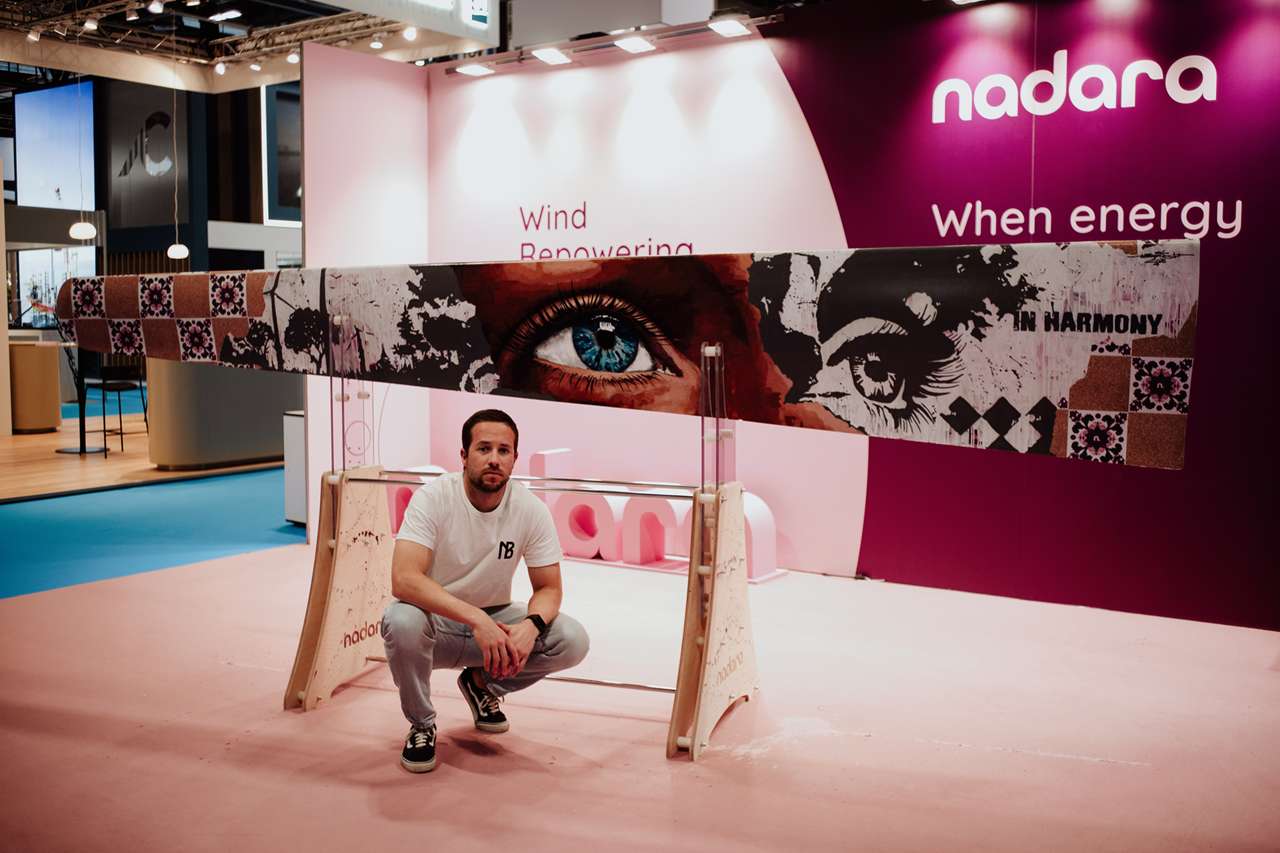
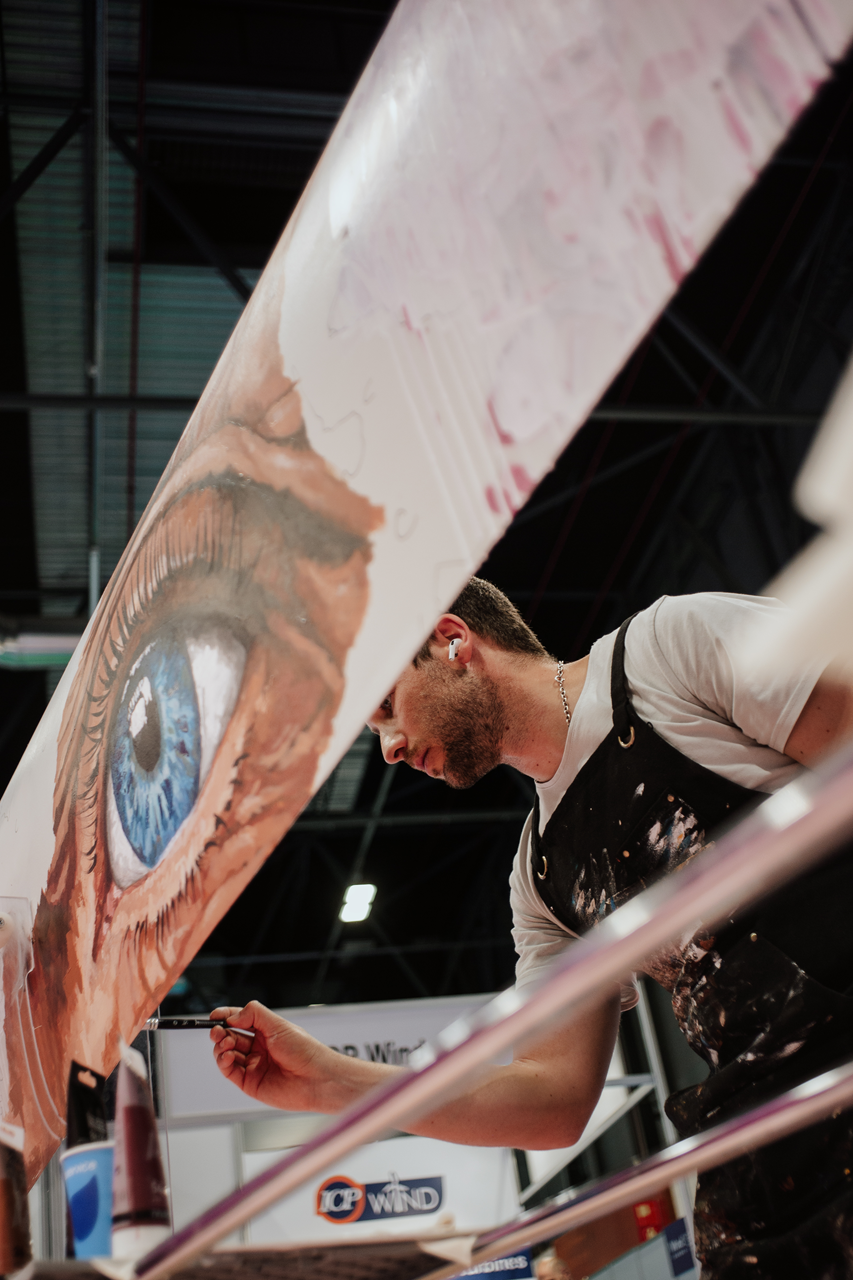
At WindEurope in Madrid, we brought a section of a decommissioned wind turbine blade into the exhibition hall. Over three days, Portuguese street artist Edis One transformed it into a work of art, live, in public, as the conference happened around him. We called the initiative 'Wind Repowering Communities'.
People stopped. They asked questions. Some of those conversations went places that a presentation slide never would.
That was the point.
The 'Wind Repowering Communities' blade is a small expression of something bigger.
The industry is at a turning point
Wind energy is maturing. That is a good thing. But maturity brings decisions that the sector has not always been forced to confront before.
Across Europe, thousands of onshore wind turbines are approaching the end of their operational life. Owners face a choice: decommission, extend, or repower.
Repowering means replacing older turbines with fewer, more powerful, more efficient modern machines. It is the only option that keeps a site generating renewable energy at the scale the transition requires. The same site. The existing grid connection. Up to ten times more output, depending on conditions.
It is also the hardest option to plan, permit, and deliver.
At Nadara, we operate one of Europe's most diverse onshore wind portfolios. Our assets span multiple countries, turbine generations, and operational ages. Repowering is not a future consideration for us. It is active, ongoing, and increasingly central to how we think about our role in the energy transition.
What comes down matters too
Repowering also means decommissioning. That part of the process gets less attention than it deserves.
When a turbine comes down, every component represents a decision. Reuse it within the portfolio. Repurpose it into the community. Recycle it through local partners. Or send it to landfill. That choice is increasingly hard to justify, and in our view, one the industry should move away from entirely.
At our Plouvien wind farm in northwest France, we recently decommissioned six turbines. Working closely with our contractor, we achieved a project recovery rate of 98 per cent across more than 1,000 tonnes of material. Zero landfill. Components redistributed across our wider portfolio. Materials recycled through local partners.
That is not a one-off. It is a standard we are building towards across every decommissioning project we run.
The blade in the Madrid artwork came from a real site being repowered. It did not go to waste. It went to WindEurope. And this autumn, it will be gifted to a community local to one of our Spanish wind farms. A physical, lasting connection between the turbine's first life and the next chapter for that site.
Communities are not a consultation exercise
The communities around our wind farms have been part of the energy transition for decades. Some have lived alongside the same turbines for 25 years. When those turbines come down, and when new ones go up, the process should reflect that relationship.
At Nadara, we work closely with local communities throughout repowering. Not to manage objections. To genuinely understand what responsible decommissioning looks like for them. What materials can be retained or repurposed locally. How benefit funds can continue and grow. What the next 25 years can offer that the last 25 did not.
The 'Wind Repowering Communities' blade is a small expression of something bigger.
The energy transition will not succeed if communities feel it is something being done to them. It has to be something done with them.
Asking better questions
The industry is full of conversations about what needs to change. We want to be part of making that change visible.
'Wind Repowering Communities' was not a marketing exercise. It was a provocation, and an honest one. The questions it raised about repowering, sustainable decommissioning, and community partnership are ones we are actively working through ourselves.
We don’t have all the answers. But we are asking the right questions, and we are doing it openly.
If these are conversations you are having too, we would like to hear from you. Read more about how we approach repowering and our thinking on sustainable decommissioning.
Sam Ballard is the Senior Brand & Campaigns Manager at Nadara. With over 20 years in marketing, brand and communications, 16 of them in renewable energy, Sam leads Nadara's external communications and has shaped campaigns on repowering, asset performance, sustainability and brand. He believes some of the most important conversations in the energy transition are the ones the industry is still learning to have out loud.